
Germany's Autobahn Is Choking - and European Freight Is Paying the Price
Trucks lost over 50 million hours to congestion on German motorways in 2023. Why the Autobahn is failing freight, what it costs carriers, and how to plan around it.
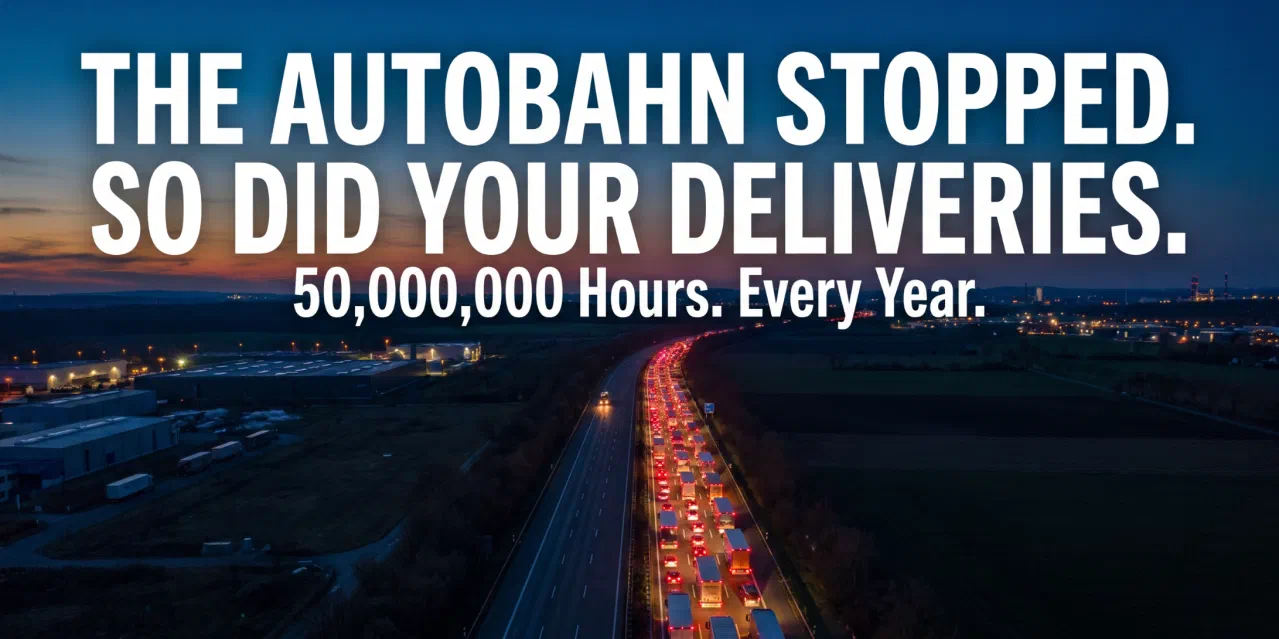
There’s a brutal irony at the heart of European logistics. The country that invented the motorway, the gold standard of road infrastructure for nearly a century, has become one of the continent’s most punishing bottlenecks for freight. Germany’s Autobahn isn’t failing because it was badly designed. It’s failing because decades of underinvestment, relentless traffic growth and a freight system still overwhelmingly dependent on asphalt have pushed it past its limits.
For carriers and forwarders moving goods across Europe, that failure has a very real cost. This isn’t an abstract infrastructure policy debate. It’s a daily operational reality that eats directly into margins, reliability and client relationships.
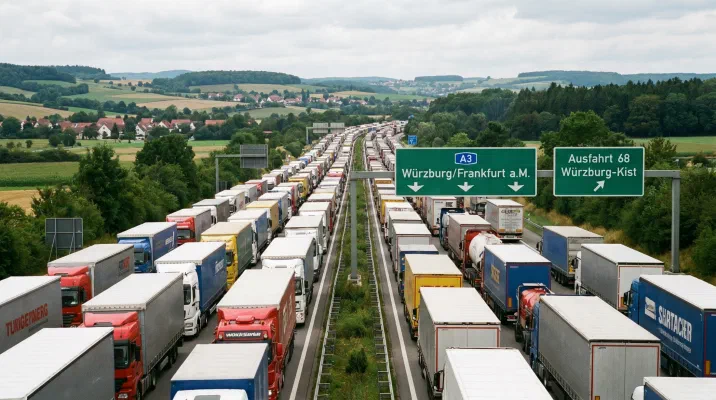
Fifty million hours. In a single year.
In 2023, trucks lost more than 50 million hours to congestion on German motorways. Read that again. Fifty million hours. That’s not a statistic you absorb with a shrug. It’s an operational catastrophe playing out in slow motion, one standstill at a time.
Germany operates over 13,000 kilometres of motorway, the third-largest network in Europe. On paper, it should be the continent’s freight superhighway. In practice, key corridors including the A3, A5, A8 and A61 regularly operate at or beyond capacity. The Federal Highway Research Institute (BASt) has documented thousands of recurring bottlenecks across the network. These aren’t temporary inconveniences. They are structural, predictable and worsening year on year.
How did it come to this?
This didn’t happen overnight. Germany’s motorway infrastructure was largely built in the post-war decades. It was designed for different traffic volumes, a different economy and different demands. European integration and the e-commerce boom brought explosive growth in freight volumes that the network was simply never built to absorb.
Chronic underfunding through the 1990s and 2000s left a deep maintenance deficit that is only now being addressed. The result is visible everywhere: roughly 4,000 kilometres of Autobahn are under some form of construction at any given time. The repairs are necessary. But every construction zone is another slowdown, another source of queues, another unpredictable variable in route planning.
Rail promises, road dominates
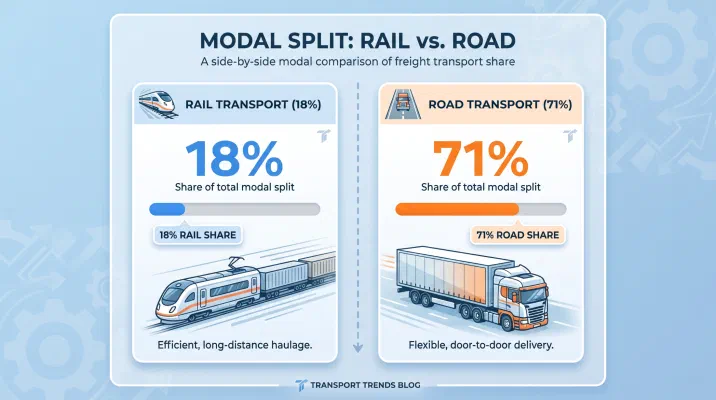
Alongside the physical state of the network sits a deeper structural problem in how freight is distributed across transport modes. Rail carries around 18% of German freight. Road accounts for over 70%. Despite genuine political ambition to shift more cargo onto rail, the practical reality remains unchanged: the vast majority of cross-border European freight still rolls through Germany on four wheels.
Until that balance shifts meaningfully, pressure on the motorway network will not ease. And shifting that balance isn’t a question of one legislative season. It is a project measured in decades.
What this actually means for your business
If you’re dispatching trucks through Germany daily, you already know the operational maths from first-hand experience. A missed delivery window doesn’t stay contained. It cascades.
A driver stuck for three hours on the A5 near Frankfurt doesn’t just lose those three hours. That delay can invalidate a pre-booked ferry crossing. It can trigger a missed unloading slot at a distribution centre. The driver hits regulated rest time that wasn’t factored into the schedule. One incident becomes a full-day unravelling.
For forwarders quoting transit times to clients, the margin for error has shrunk dramatically. Offering competitive delivery windows while absorbing the uncertainty of German congestion is a daily exercise in risk management that never fully resolves.
Costs rise. Credibility suffers.
The impacts aren’t only operational. They’re financial. Fuel costs spike when trucks idle for hours in stationary traffic. Driver costs escalate with every extended delay. Late-delivery penalties, compensation claims, lost reliability bonuses - it all adds up faster than most P&Ls comfortably reflect.
And when things go wrong - when that promised delivery window is missed - it isn’t just an added invoice. It’s the forwarder’s credibility on the line. In an industry where reputation takes years to build and moments to damage, that may be the most expensive consequence of all.

Adaptation is not optional. It is survival.
The freight companies managing Germany’s congestion best right now are not waiting for infrastructure policy to rescue them. They are adapting tactically and systematically.
Night-time and weekend driving windows, when traffic volumes drop significantly, are being built into route planning more deliberately than ever before. Alternative corridors through Austria, Switzerland or the Benelux route - though sometimes longer in distance - deliver more consistent and predictable transit times on certain lanes. Real-time traffic intelligence platforms have moved from a nice-to-have into essential operational infrastructure for any serious dispatch operation.
Intermodal: not the future - the present
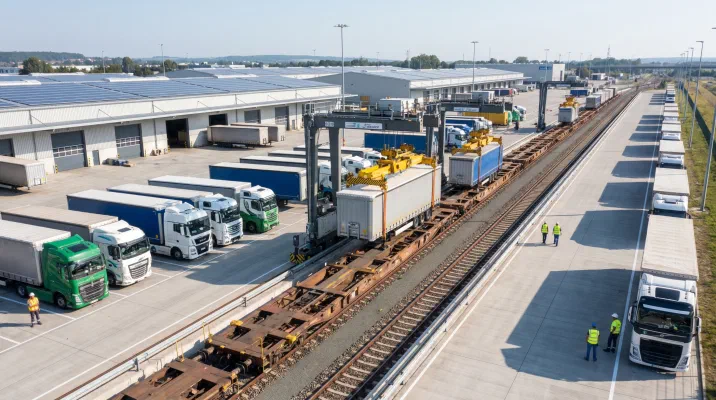
Some operators are going further still. They are exploring intermodal solutions on high-volume lanes: road-to-rail transfers that bypass the worst German bottlenecks entirely. On north–south axes in particular, combining truck and rail can deliver not only greater predictability but also meaningful cost savings at the right volumes.
None of these approaches is a perfect solution. All of them are necessary responses to a network that is no longer reliably delivering what it promises.
Conclusion: don’t wait for the fix. Plan around it.
The Autobahn built a reputation over generations. Congestion is quietly dismantling it. Germany’s infrastructure investment programme is real and significant - billions have been committed. But construction timelines are long, disruption during works is severe, and meaningful relief is still years away.
For freight professionals operating right now, in the middle of this crisis, the challenge is clear: build Germany’s volatility into your planning not as an exception, but as the baseline. The companies that treat German congestion as a temporary problem to be waited out are the ones who will keep getting hurt by it.
How are you adapting your routing strategies to work around Germany’s congestion? Tell us - or send us a lane you are struggling with.
Originally published on LinkedIn.