
How AI Will Change Transport and Freight Forwarding Over the Next 10 Years
Prediction instead of improvisation, a new role for the dispatcher, autonomous trucks and drones, and lower emissions. How artificial intelligence will reshape road freight by 2035.
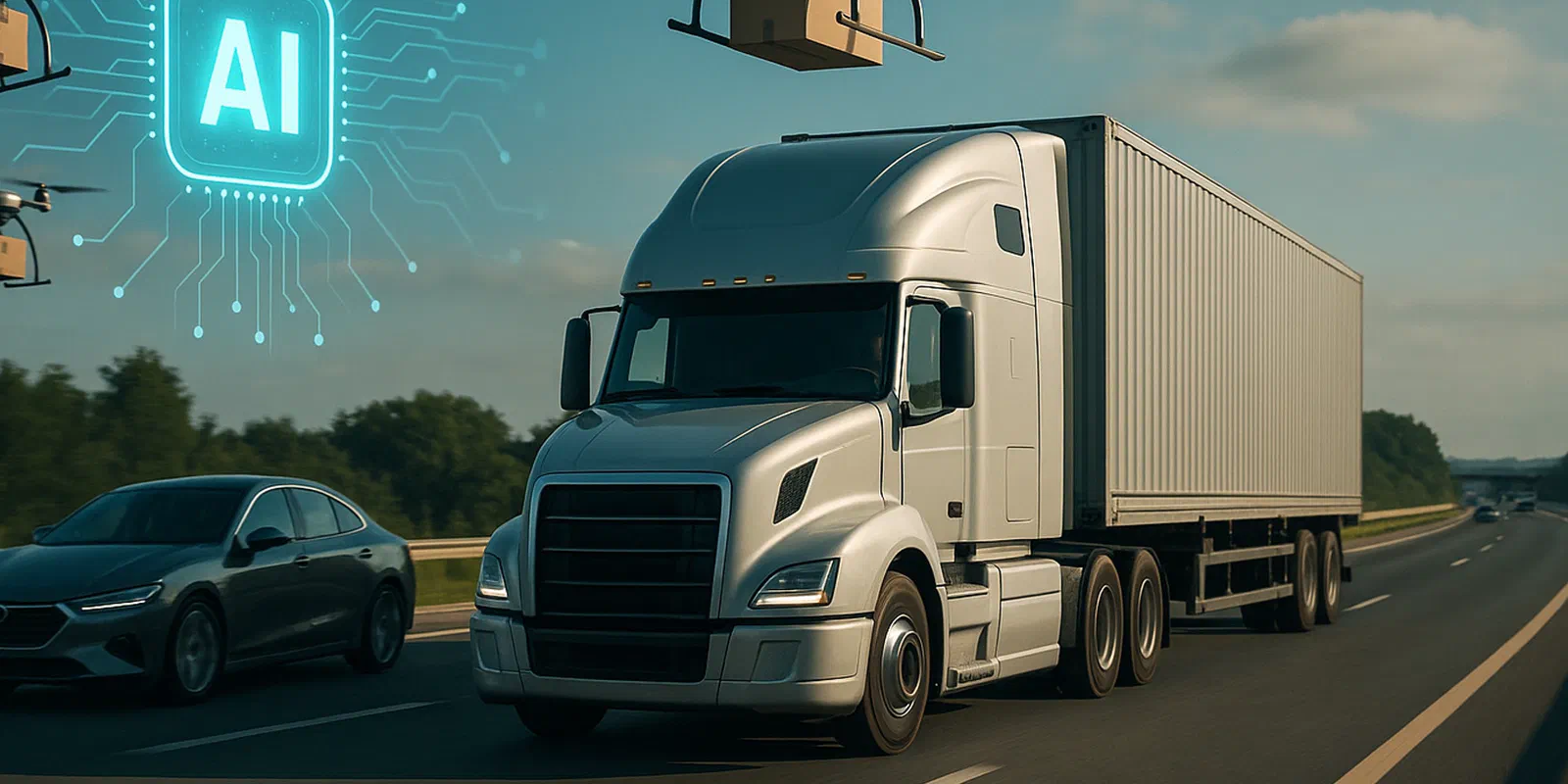
Artificial intelligence stopped being a conference topic a long time ago - it is now a fixed part of logistics and transport. Automated warehouses, intelligent route optimisation and chatbots that answer customer questions instantly are already reality. But what we know today is only the first chapter. The next ten years will bring changes capable of reshaping transport and forwarding from the ground up, and of setting entirely new standards for how goods get from A to B.
Prediction instead of improvisation
Transport and logistics have always worked with a large number of variables: weather, traffic, vehicle breakdowns, unexpected customer requirements. In the past you could only react once the problem had already happened. AI changes that fundamentally. Its ability to analyse enormous volumes of data in real time makes it possible to anticipate risks and propose solutions before they occur.
Imagine a dispatch desk that knows a day in advance that a stretch of motorway will be impassable because of an accident or planned maintenance. The system recalculates the route automatically, taking into account the delivery time, fuel consumption and even the driver’s mandatory rest periods. The result is a smoother operation and more reliable service. A customer who today waits to be told about a delay could, ten years from now, receive a proactive notification with the exact reason and a proposed alternative.
The dispatcher’s new role
A dispatcher’s job today is extremely demanding. It means coordinating a fleet of vehicles, drivers and deadlines, where every mistake costs time and money. AI can transform that role fundamentally. Algorithms will not merely assist - they will gradually take over most operational planning.
Imagine a system that assigns shipments to specific vehicles on its own, plans the route around both capacity and the driver’s legal obligations, and reacts to problems in real time. People will no longer have to constantly juggle customer requirements against vehicle availability. The dispatcher’s role shifts towards strategic oversight: checking the system’s decisions, handling special cases and talking to key clients.
That change also brings better work. Instead of monotonously watching spreadsheets and making phone calls, the dispatcher becomes a partner who has time to look for longer-term solutions and develop customer relationships. For companies it means better use of human capital and a lower risk of the errors that manual planning produces.
Autonomous transport and new solutions
Perhaps the most discussed trend in logistics is autonomous transport. Self-driving trucks have already completed their first test runs and drones routinely deliver shipments in some countries. Within ten years we may see them deployed more widely in Europe too.
Self-driving vehicles can run practically non-stop, which could dramatically reduce the time needed to deliver goods over long distances. Some of the constraints tied to the human factor - fatigue, stress, breaks - fall away. That does not mean drivers disappear. They will most likely move into oversight roles, fleet management, or operating in complicated urban environments that autonomous systems will not handle for a long time yet.
Drones, meanwhile, offer a solution for the last mile - the hardest and often most expensive part of logistics. Delivering a parcel straight to a company’s yard or roof can save tens of minutes otherwise spent looking for parking or walking. Safety, legislation and battery capacity remain the challenges, but technological progress suggests these obstacles will gradually be overcome.
Efficiency and sustainability
Beyond speed and accuracy, AI also brings a strong environmental dimension. Transport companies face long-term pressure to reduce both costs and their carbon footprint. Artificial intelligence can optimise fuel consumption by proposing routes with fewer empty kilometres, or by intelligently combining modes of transport - road, rail and sea.
Customers increasingly expect companies to take sustainability seriously. A carrier that can demonstrably show lower emissions or a greener delivery method gains a competitive advantage. So AI is not only about efficiency - it is also about building a credible brand.
The question for the years ahead is therefore not whether AI becomes a normal part of forwarding, but how fast and how far. Those who start experimenting now will have a head start in technology, processes and reputation. Companies that wait risk being overtaken by competitors, not only in efficiency but in the eyes of their customers.